
The Other Driver’s Insurer Is Already Building a Case. Are You?

The Other Driver’s Insurer Is Already Building a Case. Are You?
The call I remember most clearly came from a woman I’ll call Diane. She’d been rear-ended at a red light three days earlier—clear liability, no ambiguity. The other driver had even apologized at the scene. By the time she reached me, she’d already given a recorded statement to the at-fault driver’s insurance company, mentioned that her neck “felt a little stiff but was probably fine,” and agreed to let them handle everything. She was calling because something felt off.

It was. That “probably fine” comment had already been logged. The adjuster had been pleasant, efficient, and completely focused on closing her claim as cheaply as possible. Diane wasn’t suspicious because nothing about the interaction felt adversarial. That’s exactly how it’s designed to work.

I’m not telling you this to frighten you. I’m telling you because Diane did everything a reasonable, polite person would do—and it nearly cost her. You deserve better than that.

What the First Hour Actually Decides

The moments right after a crash feel chaotic, but they’re also when your claim is most vulnerable and most shapeable. What you do—and don’t do—in that first hour creates the foundation everything else is built on.

If anyone is injured, call 911 immediately. Don’t negotiate that decision. A responding officer creates an official record that neither insurer can easily rewrite later. If the crash happens on private property—a parking lot, a gas station—California’s official guidance notes that some police authorities won’t respond to those scenes, which makes your own documentation the only record that exists.

Here’s what to collect before you leave the scene:

  • Driver’s license — ask to see it directly, not just a photo someone hands you
  • Vehicle registration — verify it matches the driver’s information
  • Insurance card — carrier name, policy number, contact information
  • License plate — photograph it, don’t just write it down
  • Witness names and phone numbers — don’t assume police will collect these

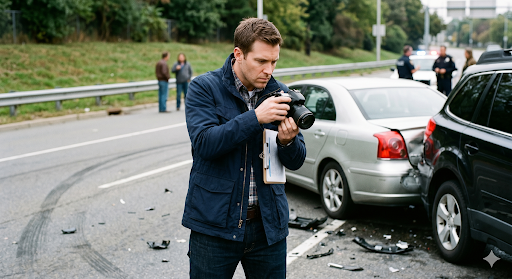
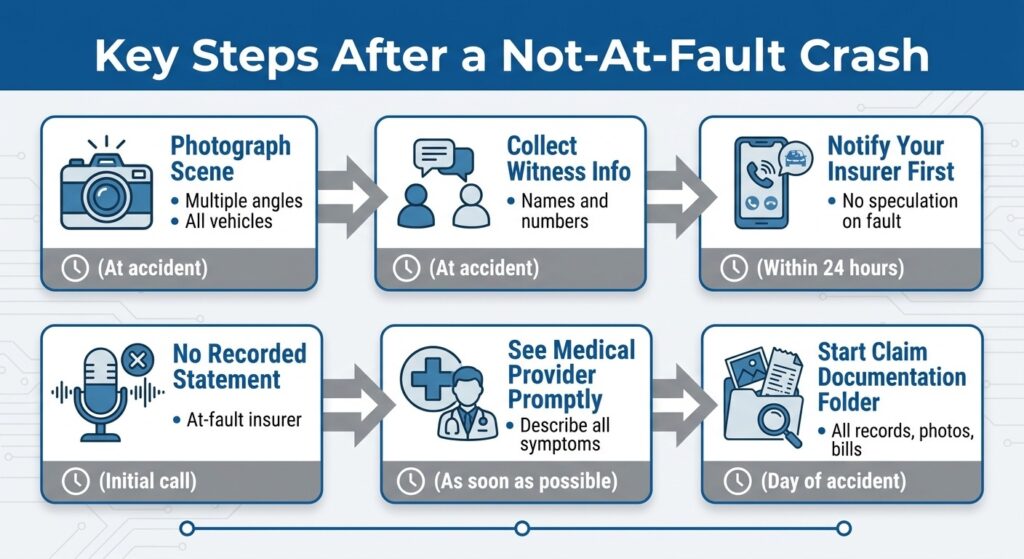
Photograph everything you can safely reach: both vehicles from multiple angles, the point of impact, skid marks, traffic signals, street signs. Do this before anyone moves the cars if possible. Photographic evidence doesn’t argue, doesn’t forget, and doesn’t get nervous under questioning.

Witnesses are worth more than most people realize. A bystander who saw the at-fault driver run a red light can be the difference between a disputed claim and a resolved one.

The 24-Hour Window: Two Calls You Need to Make

Once you’re away from the scene, the clock on several important notifications starts running. The sequence matters.

CallWhoWhat to SayWhat to Avoid
FirstYour own insurerDate, location, other driver’s name; confirm you’re reporting as requiredDon’t speculate on fault or injuries
SecondAt-fault driver’s insurerConfirm the accident occurred; provide basic facts onlyDon’t agree to a recorded statement

Notify your own insurance company first. This feels counterintuitive—why involve your insurer when you didn’t cause the accident? Because your policy likely requires prompt notification of any collision, and because your insurer can sometimes advocate on your behalf or provide coverage options like uninsured motorist protection if the at-fault driver’s coverage falls short. You’re not filing a claim against yourself. You’re activating a resource you’ve been paying for.

When you contact the at-fault driver’s insurance company, keep the initial call factual and brief. The adjuster on the other end is experienced, friendly, and working toward a specific outcome that may not align with yours.

The recorded statement question will almost certainly come up. The at-fault driver’s insurer has no legal right to compel you to give one. Consumer protection guidance is direct on this point: don’t give statements without first seeking advice, because insurers can and do use those statements in the claims process. You can simply say: “I’m not prepared to give a recorded statement at this time. I’ll be in touch once I’ve had a chance to review my situation.” That’s not combative. That’s reasonable.

Building Your Documentation System

This is where a lot of injured parties lose ground without realizing it—not through one dramatic mistake, but through scattered, incomplete records that leave gaps the other insurer is happy to fill with their own interpretation.

Start a dedicated folder the day of the accident. Everything goes in it.

What belongs in your claim folder:

  1. Police report number and instructions for obtaining the full report
  2. All scene photographs, timestamped
  3. The other driver’s complete information
  4. Witness names and contact details
  5. Your own written account of what happened (written while memory is fresh)
  6. Every communication with any insurance company, summarized in writing after each call

The police report deserves specific attention. Once it’s available, obtain a copy and read it carefully. Officers sometimes record details incorrectly—wrong vehicle descriptions, transposed names, or a narrative that doesn’t match what witnesses saw. If there’s an error, you can typically request a correction or submit a supplemental statement. An uncorrected error in an official report can create friction in your claim that takes real effort to undo.

If the other driver was cited, that citation matters. If they weren’t, your photographic evidence and witness accounts become even more important.

Medical Documentation: The Part People Underestimate Most
Adrenaline is real.

After a crash, many people genuinely don’t feel hurt—or feel only mildly uncomfortable—and decide to wait and see. A week later, the neck stiffness that seemed minor has become something that disrupts sleep and limits movement. But now there’s a gap in the medical record, and the insurance company will point to that gap as evidence the injury wasn’t serious or wasn’t caused by the crash. This is one of the most predictable and preventable ways strong claims get undermined.

See a medical provider as soon as possible, even if you feel okay. Tell them you were in a motor vehicle accident. Describe every symptom, even the ones that seem minor—headache, stiffness, soreness, difficulty concentrating. Let the provider document what you’re experiencing. That documentation creates a contemporaneous medical record tied to the date of the crash, which is far harder to dismiss than a visit two weeks later.

What to track and keep:

  • Every medical bill, even small copays
  • All treatment records and discharge summaries
  • Prescription receipts
  • Documentation of missed work days and lost wages
  • Out-of-pocket expenses related to the injury (transportation to appointments, home care, etc.)

The full picture of your damages is what an insurance claim is ultimately measured against. You need that picture to be complete and organized before you negotiate anything.

If your injuries are significant, or if the insurance company starts pushing back on your claim, this is the moment to consider consulting a personal injury attorney boston or wherever you’re located. Not because you’re being aggressive—because an attorney who handles these cases regularly knows what your claim is actually worth, knows how to respond to lowball offers, and can prevent you from settling for less than you need before you know the full extent of your recovery. Most work on contingency, meaning no upfront cost.

When the Other Insurer Pushes Back

So you’ve done everything right, and the at-fault driver’s insurance company is still making things difficult. Maybe they’re disputing liability. Maybe they’re offering a settlement that doesn’t come close to covering your medical bills. Maybe they’ve gone quiet.

Understand this clearly: the adjuster’s job is to resolve claims efficiently for their employer. They are not your advocate. They may be polite, even sympathetic, but their professional incentive is to close your claim at the lowest defensible number. That’s not cynicism; it’s just how the business works.

Three things to do when pushback starts:

  1. Put everything in writing. If they’re disputing fault despite a police report and photographic evidence, that dispute needs to be addressed in writing. Follow up every phone call with an email summarizing what was discussed. Create a paper trail that shows what was said and when.
  2. Don’t accept a settlement before treatment ends. If a settlement offer comes in before you’ve completed medical treatment, be very cautious. Once you sign a release, that’s typically final—you can’t go back for additional compensation if your injury turns out to be more serious than initially thought.
  3. Get a professional evaluation of any offer. Before you respond to a number, understand what that number actually covers relative to your documented damages and anticipated recovery.

The Concerns I Hear Most Often

“I wasn’t at fault—why do I have to do all this?”

Because fault and compensation aren’t the same thing. Being not at fault means the other driver’s insurer is financially responsible. It doesn’t mean they’ll pay fairly without documentation to support your claim. The evidence you gather is what turns legal responsibility into actual compensation.

“Won’t getting a lawyer make me seem difficult?”

No. It makes you seem like someone who understands the process. Insurance companies deal with attorneys every day. What they’re counting on is that you won’t consult one—that you’ll accept the first offer because you don’t know what your claim is worth.

“I feel fine right now. Do I really need to see a doctor?”

Yes. Symptoms from whiplash, soft tissue injuries, and even mild concussions can take days to fully surface. A medical visit now creates the record that protects you later. Skipping it is one of the most common and costly mistakes in otherwise solid claims.

Your Next Concrete Steps

If you’re reading this right after a crash:

Photograph the scene. Get witness contacts. Request the police report. See a medical provider today. Notify your own insurer. Do not give a recorded statement to the at-fault driver’s insurer without guidance.

If you’re a few days out and already feeling the pressure:

Pull together everything you have. Get to a doctor if you haven’t already. Consider a free consultation with a personal injury attorney before you respond to any settlement offer. Post-crash guidance consistently reinforces this sequence—and for good reason. The steps build on each other, and skipping one creates gaps the other side will use.

You’re not being paranoid. You’re not overreacting. You’re doing what anyone should do when they’ve been injured and someone else is responsible—making sure your voice is part of the record before the other side finishes writing it.
Beyond the Courtroom: Alternative Dispute Resolution in Car Accident Cases

In the aftermath of a car accident, seeking compensation for injuries and damages often involves a legal process that can be time-consuming and adversarial. However, not all car accident cases need to be resolved through traditional litigation. Alternative Dispute Resolution (ADR) methods, such as mediation and arbitration, offer a more amicable and efficient way to resolve disputes outside the courtroom, with the guidance of a skilled Bronx car accident attorney.

Understanding Alternative Dispute Resolution (ADR)

Alternative Dispute Resolution (ADR) encompasses a range of processes and techniques designed to help parties in conflict resolve their disputes without going to court. ADR methods emphasize communication, cooperation, and compromise as alternatives to adversarial litigation. Two common ADR methods used in car accident cases are mediation and arbitration.

The Role of Car Accident Attorneys in ADR

Car accident attorneys play a crucial role in the ADR process. They provide legal expertise and guidance to their clients, ensuring their rights and interests are protected throughout ADR proceedings. Attorneys also help clients navigate the complexities of ADR agreements and advocate for favorable outcomes.

Mediation: Resolving Disputes Amicably

Mediation is a voluntary and confidential process in which a neutral third party, the mediator, assists the parties in dispute to communicate, identify issues, and explore potential solutions. The mediator does not make decisions but helps the parties reach a mutually acceptable resolution.

In a car accident case, mediation typically involves the following steps:

  • Selection of a Mediator: Parties choose a qualified mediator with experience in car accident cases.
  • Opening Statements: Each party presents their perspective and objectives.
  • Negotiation Phase: The mediator facilitates discussions and helps parties explore settlement options.
  • Reaching a Resolution: If both parties agree, a settlement is reached, and a binding agreement is drafted.

Mediation offers numerous benefits, including reduced costs, faster resolution, and a less confrontational atmosphere. Car accident attorneys play a crucial role by advocating for their clients’ interests during mediation.

Arbitration: A Quicker Alternative to Litigation

Arbitration is another ADR method in which a neutral third party, the arbitrator, acts as a decision-maker. Unlike mediation, the arbitrator renders a binding decision based on the evidence presented by the parties. Arbitration is typically faster and less formal than traditional litigation.

Key elements of arbitration in car accident cases include:

Selection of Arbitrators: Parties may jointly select an arbitrator or agree on a panel of arbitrators.

Presentation of Evidence: Each party presents their case, including witnesses and documents.

Arbitration Award: The arbitrator issues a decision, known as an arbitration award, which is legally binding.

Arbitration is often chosen for its speed, efficiency, and cost-effectiveness compared to courtroom litigation. Car accident attorneys represent their clients’ interests during arbitration, presenting evidence and arguments to support their claims.

Benefits of ADR in Car Accident Cases

Alternative Dispute Resolution offers several advantages when resolving car accident cases:

1. Reduced Time and Costs

ADR methods are generally quicker and less costly than traditional litigation, which can involve lengthy court proceedings and legal fees.

2. Increased Control

Parties have more control over the outcome and the terms of a settlement, leading to a greater sense of satisfaction with the result.

3. Less Adversarial Nature

ADR encourages cooperation and communication, fostering a more amicable resolution process that can help maintain relationships.

4. Customized Solutions

Mediation and arbitration allow parties to craft creative and tailored solutions that meet their specific needs and priorities.

5. Confidentiality

ADR proceedings are confidential, reducing the public exposure of personal and sensitive information.

When Is ADR Appropriate?

ADR is appropriate in various car accident scenarios, including when:

  • Both parties are willing to cooperate and negotiate in good faith.
  • There is a desire to maintain a more amicable relationship.
  • Parties seek a quicker resolution to their dispute.
  • Traditional litigation is cost-prohibitive or impractical.

However, it’s essential to consult with a car accident attorney to determine whether ADR is suitable for your specific case.

The ADR Agreement: What to Expect

Before proceeding with ADR, parties must agree to participate voluntarily. The ADR agreement typically includes key provisions, such as:

  • The selection of a neutral third party (mediator or arbitrator).
  • The process and timeline for ADR proceedings.
  • The scope of the issues to be resolved.
  • The confidentiality of the proceedings.

Both parties must consent to ADR as an alternative to litigation.

Preparing for ADR with Your Attorney

Preparing for ADR requires thorough groundwork, and your car accident attorney plays a pivotal role. Steps include:

  • Gathering evidence to support your case.
  • Assessing the strengths and weaknesses of your position.
  • Setting clear objectives for the ADR process.
  • Collaborating closely with your attorney to develop a negotiation strategy.

The ADR Session: What Happens

During an ADR session, parties engage in negotiations, facilitated by a mediator or presented to an arbitrator. The process includes:

  • Opening Statements: Each party presents their perspective and objectives.
  • Negotiation Phase: Parties discuss issues, explore potential solutions, and negotiate terms.
  • Reaching a Resolution: If parties agree, a settlement is reached and documented.

Throughout the session, your car accident attorney will advocate for your interests and help you navigate the process effectively.

The Outcomes of ADR

The outcomes of ADR can vary:

Full Settlement: Parties reach a complete agreement, and the case is resolved.

Partial Agreement: Parties resolve some issues but not all, requiring further negotiation or arbitration.

Impasse: Parties are unable to reach an agreement, and the dispute may proceed to litigation.

It’s important to note that arbitration awards are binding, while mediated settlements are enforceable agreements.

ADR vs. Litigation: A Comparative Overview

While ADR offers numerous benefits, it may not be suitable for all cases. It’s essential to consider the advantages and disadvantages of ADR compared to traditional litigation. Factors such as the willingness of parties to cooperate, the complexity of the case, and the desire for a more collaborative approach can influence the choice between ADR and litigation.

Conclusion

Alternative Dispute Resolution methods like mediation and arbitration offer valuable alternatives to traditional courtroom litigation in car accident cases. With the guidance and advocacy of a skilled car accident attorney, individuals involved in car accident disputes can explore these avenues for resolution, leading to quicker, more cost-effective, and less adversarial outcomes. When considering ADR, consult with your attorney to determine the most suitable path for achieving a fair and satisfactory resolution to your car accident case.

When Does The Law Allow You To Sue Someone For Personal Injury?

Personal injury is compensation for injuries caused by someone else’s negligence. The law is rigorous about what counts as a personal injury, although there are numerous grounds to suit. You can only sue someone if their carelessness directly caused your harm, however this may get tricky with serious injuries (such as brain damage) or indirect repercussions of accidents (such as infections). If your case qualifies for compensation, the court or jury will decide how much to pay based on variables such as the severity of your injuries and who was at fault.

What Are Personal Injuries

Personal injury is a general term used to refer to any type of harm that affects your body, mind or emotions. This could include injuries caused by someone else’s negligence or defective products.

Examples of personal injuries:

  • Injuries to the brain (e.g., head trauma)
  • Injuries to the spinal cord (e.g., back injuries)

When Can You Sue For Personal Injuries

The law allows you to sue someone for injuries if they were at fault and your injury was severe. You need to show that the person who caused your injury was negligent, meaning that they did not take reasonable care. If this happened in New Jersey or any other state in the country, then injured parties may be able to recover compensation from their negligent driver by filing a personal injury law against them.

You Have To Prove That Someone Has Been Negligent

Negligence is a legal term that means someone has been careless or negligent. It can be proven by showing that the person did not do what they should have done in order to prevent harm from coming to you.

For example, if you are walking down the street and a driver fails to stop at a red light, causing you to get hit by a bus and sustain injuries then it would be considered negligence on your part as well because there are laws in place stating that drivers must stop at red lights when pedestrians are near them. In this situation, it’s not just about proving someone else was negligent but also proving that your injuries were caused by their actions of not stopping at the light despite knowing better (negligence).

Personal injury claims are serious business, and it’s important to know the steps you need to take in order to make a claim. At the same time, you should be aware of the limitations on what you can sue for. If your injury is severe or life-changing, then by all means go ahead with legal action against those responsible for causing your problem! If not… well… maybe now’s not such a good time after all?

Crown Point personal injury lawyer is a highly experienced and dedicated legal professional who specializes in representing individuals who have been injured due to the negligence of others.

Do You Have To Be Badly Injured To File An Auto Accident Lawsuit?

If you have been injured in an auto accident, you may be wondering if you have the right to file a lawsuit. You may also be wondering how the process works and who can best help you. If so, this article is for you.

Do You Have To Badly Injured To File An Auto Accident Lawsuit?

  • You can file a lawsuit even if you were partially responsible for the accident.
  • You can file a lawsuit even if your injuries are not visible.
  • You can file a lawsuit even if you do not have insurance.

How Do You File An Auto Accident Lawsuit

You can file an auto accident lawsuit in civil court. You will have to prove that the other driver was at fault for causing the accident and that your injuries are a result of this negligence. If you were not injured at all, but still want compensation for property damage, you may also file a claim against their insurance company.

If you were not driving when the accident occurred and were hurt by someone else’s vehicle while standing on public property (such as on a sidewalk), then it is likely that you are entitled to damages from their insurance company. This law applies regardless of who caused the crash and whether or not they were ticketed for breaking traffic laws prior to hitting your car.

How Can An Auto Accident Attorney Help

An attorney can help you get the compensation you need. This means that they will help you file a claim and get your car fixed or replaced, as well as any other damages the accident caused. They can also assist with getting medical care and legal advice, as well as emotional support if necessary.

If you were injured in an auto accident, it’s best to find out your rights by consulting with an experienced car accident attorney in Indiana. An attorney will be able to help you determine whether or not you have a case. They’ll also be able to provide guidance when deciding what steps to take next. If the other driver’s insurance company does not offer a fair settlement, then it is in your best interest to hire an attorney who can negotiate on your behalf.

Additionally, if your injuries are severe and are causing medical expenses that are keeping you from being able to work full time or at all, then this could qualify as catastrophic injury status. The law will consider this information when calculating how much money they should award for damages related directly back towards the accident itself (as opposed to future medical bills).

If you were injured in an auto accident, it’s best to find out your rights by consulting with an experienced auto accident attorney.

Truck Accident Law: Yes, It’s Really A Specialty

If you’ve been wounded in a truck accident, you may ask if you need a lawyer. You may have heard that automobile and truck liability standards are the same, and that’s true—but only for car drivers. When it comes to a commercial vehicle owner or operator, various elements make an accident case more challenging.

It’s A Specialty Because Of Federal Laws And Regulations

Truck accident is a specialty because of the multiple federal laws and regulations that apply to trucking companies, drivers, and carriers. For example:

  • The Federal Motor Carrier Safety Regulations
  • The Federal Highway Administration (FHWA) Regulations
  • The Department of Transportation (DOT) Regulations

It’s A Specialty Because Of The Types Of Injuries

Truck accidents are horrific and common. Truck drivers must often spend long hours away from home. This makes them more likely to have an accident than if they worked regular hours closer to home.

When struck by a semi-truck, your body and automobile are harmed. Soft tissue and spinal cord damage can result from truck accidents (SCIs). These injuries are physically and emotionally life-changing. A severe SCI can leave someone paralyzed for life or unable to care for oneself independently; this is life-changingly devastating, especially if it strikes during their prime working years when they should be able to support themselves financially.

It’s A Specialty Because There Are So Many Parties Involved

One of the reasons that truck accident law is a specialty is the sheer number of parties involved in any truck accident. There are so many different parties involved! You have the driver, their employer or company, their insurance company and any other parties who may have been involved in an accident with a truck (like another vehicle). These trucks can weigh tons and travel at high speeds down highways with other cars, so it makes sense that this is something that requires special attention from lawyers who specialize in this area of law.

It’s A Specialty Because Of The Legal Standards

Commercial cars have distinct negligence standards. If you’re hit by a truck, you must establish negligence to obtain damages in court. It’s not hard to sue a trucker. Because trucks are treated differently than cars and motorcyclists on our roadways.

When pursuing an injury claim after being hit by a commercial vehicle (including trucks, buses, limos, and ambulances), you must establish that the driver was negligent and that their carelessness caused your injuries; this is called causation. In certain areas like Florida, this might be challenging because there are so many elements that can cause an accident, including speed, response time, road conditions like wet pavement or ice patches, etc.

In addition to demonstrating carelessness and causation, there may be restrictions on how much money may be recovered from each party involved, such as another driver’s insurance company or a manufacturer of harmful equipment (e.g.: airbags).

truck accident lawyer Northwest Indiana have the expertise and knowledge to navigate the complex legal process and ensure you receive the compensation you deserve.